Showing posts with label Ezra Camp Adkins. Show all posts

Friday, April 22, 2011

Another telling of the Cloud County raid of 1869

This clipping is from 1963, and includes the hand-written text: "Mrs. Rose Myrtle Shaffer Shaver Ezra Adkins was my Uncle and Hannah Adkins was my Grandmother".

Retells Grim Story of Slaying of Settler's Child by Indians in Sibley

Editor's Note: 
(Cloud countians will be interested in the following bit of early history of this area, told by Mrs. Martha E. Lambert of Hollywood, Calif. who is a cousin of the Jane Adkins mentioned in the true story.  Mrs. Lambert is 82.  She has written the story from historical records in her possession which tell of a raid by Cheyenne Indians in the Lake Sibley settlement in which a boy of the Adkins family was murdered.)

WHEN THE CHEYENNES STRUCK LAKE SIBLEY

The sun shone with brassy brilliance on that fateful Wednesday, June 2, 1869.  Sunflowers along the Republican river drooped their yellow heads, dusty leaves flopping in the breeze like mop rags.  Farmers prayed for rain.  It was typhoid weather and many in the settlement were afflicted.  Anna Adkins was sick in bed and her brother Homer barely able to sit up.  The Sanders boy had been buried the day before, making four graves in the new cemetery.

Indians had been restless with skirmishes and raids through Nebraska and northwestern Kansas, but this little settlement of homesteaders had not been molested.

The Adkins family had been on their claim for two years.  The lure of 320 acres of FREE land (160 homestead and 160 timber file) in the young state of Kansas had been more than Homer Adkins could resist.  His wife, Hannah, hadn't been so enthusiastic.  From Hartford, Conn., Cloud County, Kansas seemed like the rim of Nowhere.  And with six children in a prairie schooner!  However, being the dutiful wife she'd argued but weakly, then planned carefully for the journey.

Hannah Adkins was not ignorant of the hardships ahead.  She'd read plenty about the rigors of the uncharted plains.  She knew about the thieves and cutthroats that infested Missouri ready to pounce on the unwary traveler, rob him of his team and leave him stranded without transportation.  She'd read about the Indians too.  The papers had been full of the story of Mary White who had been stolen, carried to the Red River country of Texas, and held prisoner for nine months until she was rescued by General George Custer.

All these things had been weighed carefully against a half section of land, in the Sunflower state.  The Adkins' claim was on the Republican river seven miles from Concordia.  Their first home was a dugout.  Hannah sewed for her family and the neighbors.  She canned fruit and vegetables.  Every available cent was carefully tucked away at the bottom of the trunk.  By 1869 she'd saved enough to send her daughter Jane to Agricultural college, at Manhattan.

Jasper, now a sturdy lad, had hired out as a farm hand for Mr. Himes.  On this tragic day he'd ridden home to visit his sick sister, Anna.

About 4:30 when Mrs. Adkins began preparing supper so that Jasper could eat with them, she discovered she was out of flour.  She called her eleven year old son, Ezra, and instructed him to take Jasper's horse and ride across the river to the Nils Nilsons' to borrow some.  She also told him to bring home the cows that were grazing among the sandhills a mile away.  Mrs. Adkins went down to the river to watch Ezra cross.  She was always fearful of the quicksand in the treacherous Republican.  In the valley across the river she saw some objects which she assumed were the cows.  She advised Ezra to go first to Mr. Nilson's, leave the sack for the flour then round up the cows and start them home.

Here is the story in part of a letter written by Hannah Adkins on June 13, 1869, to her daughter Jane in Manhattan).  

"Ezra went to Mr. Nilson's as directed, and then out among the sandhills after the cows.  He was not aware of any danger until he was surrounded by some forty to sixty Cheyennes.  Mr. Nilson could see him from his house about a quarter of a mile away.  The Indians chased him for half a mile on horseback, then Ezra jumped from the horse and ran a quarter of a mile.  Two Indians on foot ran after him and caught him.  Then an Indian road up on horseback and shot him in the face with a revolver.  Mr. Nilson said he dropped backwards, dead at the first shot, but the Indians kept on shooting.  One pierced his left eye and came out the back of his head.  The other bullet struck two inches above that tearing open the skull as as big as a man's thumb.  The Indians robbed him of the little coat you made for him.  His pants were so ragged they didn't want them.  While the Indians were killing Ezra and capturing his horse, the Nilsons made good their escape, keeping the sandhills between themselves and the Indians until they came to the woods.  They then came under cover of the woods until they got opposite our house where they waded the river.

"From our house we could see the Indians rob the Nilsons of their team and all their worldly goods.  After about an hour they set the house on fire and walked leisurely away.

"Jasper and Mr. Nilson went out after dark that night to bring our dear boy home.  We built a fire on the roof of the house so they could find their way back.  I prayed that Mr. Nilson was mistaken about Ezra being dead, but, alas it was true.  He was a mangled corpse, bespattered with blood and brains.  Mr. Dutton said he saw the Indians shoot at Ezra four times before he jumped from the horse.  The DuttonsNilsons left the settlement the next day.  Men came from the settlement with horses and wagons to take us out or help us.  Homer and Jasper were making a coffin.  We had to bury him that day because of the heat.

"There were only twenty-four at the funeral.  Men were afraid to bring their women  because of the Indians.  The funeral was conducted with more speed than solemnity.  I asked to have a prayer or a hymn, but they thought it wasn't best.

"There were forty military men at our house on Friday and Saturday.  They were called in such a hurry they came all unprepared, so our house was their headquarters, while they were roasting their coffee and enlisting men.  Lucy and I had to cook for them.  Captain Wintzel has been here today and says we will be protected.  Your father has gone with them this afternoon to find a place to station the military men.

"From your affectionate mother, H. R. Adkins."

Hannah Adkins never quite recovered from the shock of Ezra's tragic death.  At age fifty-eight she died in her sleep after having baked a cake for her youngest son's twenty-first birthday.

Monday, April 18, 2011

Cloud County Indian Raid - as told by James Nelson

This typed letter provides more detail than in the news reports about Ezra Camp Adkins
----------------------------

     This is an account of the Cheyenne Indian Raid in Cloud County, Kansas, which occurred on June 2, 1869, in which the Adkins boy was killed near the place where the Missouri Pacific railroad (Presser Ranch) now crosses the Republican River and about two miles north of Yuma, Kansas.
     This account is given by James Nelson at the urgent request of friends that the incidents of this raid be preserved for future time.
     James Nelson, at this time, being one of the few living survivors.
     This account was written September 2, 1934 by James Nelson.

     My father was emigrant agent for the Scandinavian Colonization Company and living in Chicago, Illinois; the members drew lots to divide out the land.  The land which he drew in 1868 and took out homestead papers in Junction City was N. W. ¼ Sec. I3-R.4 W-T 5S and is about two miles north of Yuma.  He had not seen the land until some of the family had moved to it.
     He sent my brother, Nels, and myself out to Kansas in March 1869 to work the farm and get it ready for the family to live on it.  We came in a covered wagon from Kansas City, Mo.  We liked the looks of the land and the location and were kept busy doing the necessary work on the farm.
     The neighbors told us about the Indian raids and depredations, but had not seen any Indians for some time.  In the meantime, my father, sister-in-law, Christine, and her one-year old baby boy joined us.  We had erected a small frame building to serve as a dwelling house.
     The second day of June, 1869, shortly before night, while Nels and I were breaking sod north and south on an eighty rod stretch and about forty rods from the house, and just as we were ready to start south, the Adkins boy rode up on a pony which his brother-in-law had borrowed from a neighbor.  The boy was about 11 years old and the son of our neighbor living to the north across the river.  He talked with us for a few minutes and rode on west about half a mile to get the Adkins cows that were grazing at the place.  Just as we were at the south end of the field and were turning around, we saw the Indians coming on their horses.  When they had covered about half the distance toward us, they discovered that Adkins boy and all of the Indians, but one, went after him.  This one Indian kept coming toward us.  I started to run toward the house.  Nels stayed with the team of horses.  The Indian undertook to cut me off from the house.  He had a spear in his left hand which he changed to his right hand and was constantly getting closer.  I kept a large revolver strapped to my belt as a part of my regular equipment; as I drew my revolver to shoot, the Indian swung to the far side of the horse and rode away to join the others.  They killed the Adkins boy, taking the pony, also the mules and horse which we had.  Nels and I made our way to the house and told the folks what had happened.  We decided to hide out as the best way to safety.  My father was an old man and quite crippled.  Father, Christine and baby went first.  Nels and I followed to protect them as best we could.  After the Indians had rounded up the pony, mules and horse, they came to the house and circled it a number of times, shooting into it as they went around to see whether or not it was occupied.  Finding it empty, they went in an helped themselves to whatever they could and wanted.
     We went to the Adkins place across the river, having to wade in the water.  As I was making my way across the river, I discovered Christine with her baby in her arms, afraid to wade further.  I put my guns down and waded out to her, taking the baby and leading the way across.  She placed her hand on my shoulder.  When we told the Adkins family that the boy had been killed by the Indians, they began to cry and scream and wish they had never come to Kansas.
     Not knowing the number of Indians that might be in the country, we waited until after dark to search for the body.  Nels and Adkins' son-in-law (Jap Scrivner) made the search.  It was about six miles coming and going to where they expected to find the boy.  Not having any roads, they were afraid they might have difficulty in finding their way back.  So we built a fire on the roof of the dugout to aid them in searching and finding their way back.  When they came back with the body of the boy there was further crying and screaming.  During the excitement we forgot about the fire on the roof.  It began to burn in the roof, so we had another scare thinking the Indians might have returned again.   When we saw what the trouble really was and became composed, we soon had the fire out.  It did very little damage.  When they buried the Adkins boy, they tore off boards from the buildings and constructed a coffin.  Some black calico and tacks were bought from town and the coffin covered with the black cloth.  When the procession started for the grave, every woman carried a gun.  There was not a flower offered up but many tears were shed.
     The next day after the raid, some of the neighbors came along with us to see our own home and to learn what damage had been done by the Indians.  It certainly was a sorry sight for us to see our things destroyed.  We had good feather ticks brought with us from our native land of Denmark.  The feathers had been emptied out and the ticks taken.  Our clothing and the washing done that day were all gone.  Corn for which we had paid a dollar and a half a bushel had been emptied out of sacks and the sacks taken.  In walking over the ground, I discovered where the Indians had emptied a hand bag of Father's in which kept some paper and some money among those papers.  There was an envelope containing 175 dollars, all of the money that Father had at that time.  We were certainly fortunate to find this as we were thus able to buy much needed clothing and provisions.  Father decided to go back to Chicago for a time and earn some money to enable the family to live.  I had a brother living near Topeka, Kansas, so decided to go to him and see if I could get some work to do.  Father and I had a chance to ride to Junction City, Kansas, with a man who had a team.  Junction City was the nearest railroad point at that time.
     As we were drawing near Clay Center we met the United States Cavalry from Ft. Riley on their way to Lake Sibley to look after the Indians.  On June 3, 1869, the day following the raid on us, the Indians made a raid on Scandia and killed a boy named Grandstead, also took a bunch of horses.  The Cavalry went up to Scandia and stayed the rest of the summer.  There was no further trouble with the Indians.
     I stayed in Topeka until the following winter when I returned to Cloud County and have lived in Cloud and Republic Counties since that time.  My father, the late Reverend Niels Nielson Sr., returned to Kansas in the spring of 1870 and in 1877 organized and founded the Saron Baptist Church which is 3 ½ miles n.e. of Jamestown, Kansas.  This is one of the few landmarks of pioneer days that still remain.
     Shortly after the Indian raid we put in a claim for $1400.00 for damage done by the Indians.  The Government told us we would have to name the tribe of Indians that did the damage; we called them Cheyennes.  47 years later the Government settled the claim for $800.00 without interest and called the Indians "Cheyennes" at that time.
James Nelson

Friday, April 15, 2011

Lucy Emma Adkins Shaffer

Amongst the memorabilia passed-down to us is a photo album that belonged to Arthur Shaffer.  This photo is of his mother, Lucy Emma Adkins Shaffer, who was Ezra Camp Adkins' older sister (and Garrett Shaffer's wife).  On the back of the photo is written: Lucy E. Shaffer  August 1888.
Lucy and Garret have a mention in this article about pioneer days in Kansas.  Another photograph is identified as "Mrs. Lucy Enna Shafffer, Age 22  Born June 3 - 1852, Plimouth Hancock Co. Ill"
------------------
This obituary is unmarked as to newspaper name or date

Mrs. Lucy Pollett
Lucy E. Adkins, daughter of Homer and Hannah Adkins, was born June 3, 1852, at Plymouth, Hancock county, Ill., and died April 20, 1940, following a heart attack at the home of her daughter, Mrs. John Shaver near Kackley, at the age of 87 years, 10 months and 17 days.

She came to Kansas with her parents in 1868 settling near Concordia and was baptized into the Methodist church at Lake Sibley at the age of 17.

She was married to Garrett M. Shaffer of Clay Center in 1871 and to this union four children were born, Emory, Arthur A. of Chandler, Okla., George F. of Monterey, Cal., and Rose M. Shaver of Courtland.  Emory died in infancy and Mr. Shaffer passed away in 1921.

She was married to Henry Pollett of Guthrie, Okla., in 1925 and Mr. Pollett died in 1926.

Surviving are her two sons and one daughter, one brother, Achel Adkins of King City, Cal., five grandchildren and three great-grandchildren.  Mrs. Pollett's brother, Esra Camp Adkins, was killed by the  Indians in 1869.

Funeral services were held Monday, April 22, at the Baptist church in Concordia with the Rev. W. H. Hawes in charge.

Monday, April 11, 2011

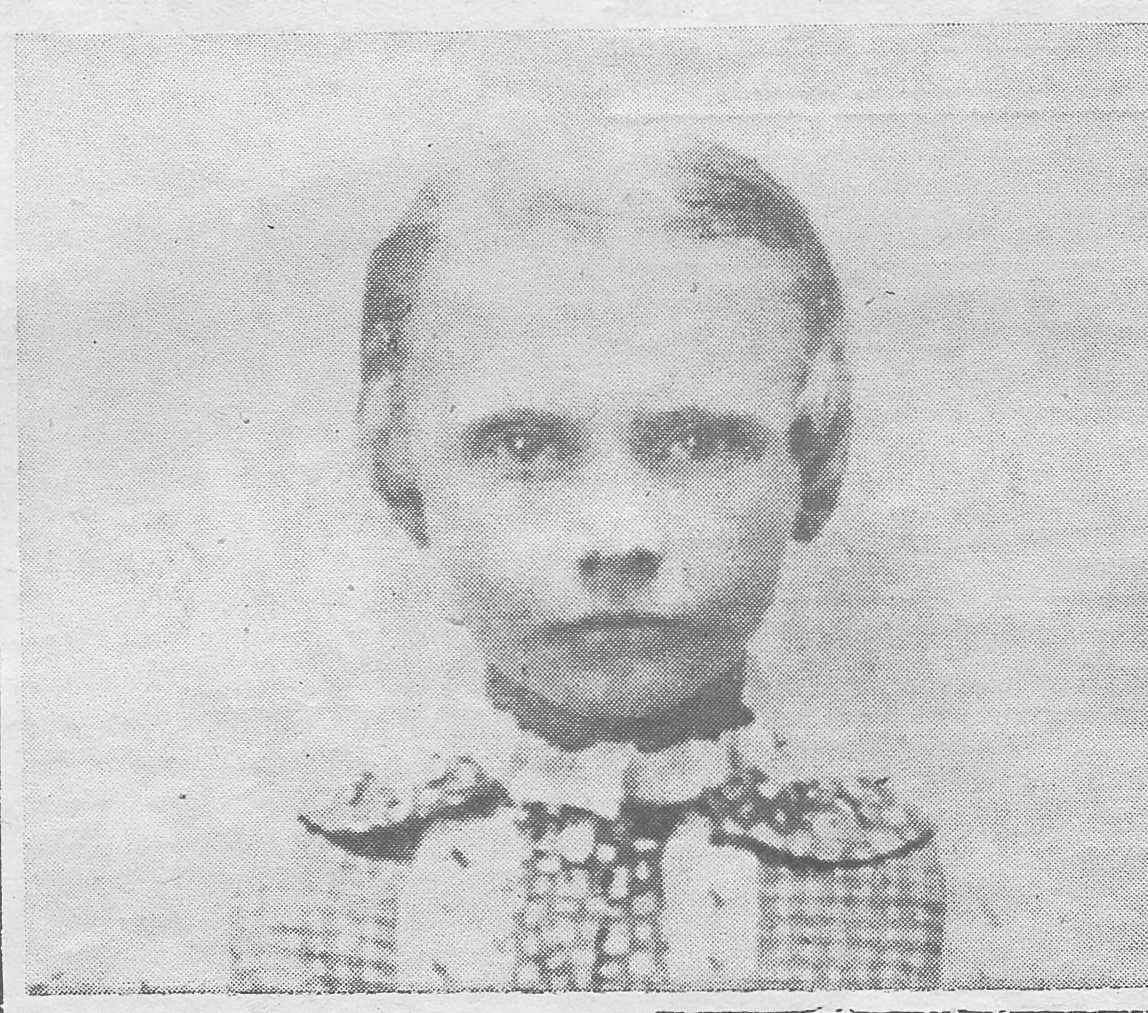
Ezra Camp Adkins

The above photograph, and the following article appeared in the "Courtland Journal" newspaper, Volume 57, Number 20, Thursday, July 7, 1960 (the text was copied verbatim):

ROMANCE, LOVE AND TRAGEDY A CENTURY AGO

     Almost 100 ears ago, a 12 year old boy by the name of Ezra Adkins was killed by the Indians.  It happened June 8, 1869.  Because he was an uncle of Mrs. John Shaver a former resident of this community, the story is of special interest.
     Anona Blackburn and Nina Engwalll visited Mr. and Mrs. John Shaver at their home in Concordia last week and were told this story.
     Mrs. Shaver's grandparents, Homer and Hannah Adkins and their seven children, Homer, Ann, Jennie, Lucy, Ezra, Paul and Achel came from Illinois to Kansas in 1868 in a covered wagon and settled on a homestead on the east side of the Republican River about eight miles northwest of Concordia.  Sibley was the nearest settlement.
     The boy, Ezra, was tending cattle on the west side of the river, not too far from his home across the river.  Indians came, took his pony and when he attempted to escape, they shot him.  He had run only about 100 yards.  His mother saw this happen.
     When it was deemed safe, the family crossed the river and brought the lifeless body to the settlement of Sibley, where burial took place.  Today, a large native stone, surrounded by small stones, marks his resting place.  However, Mrs. Shaver plans to have a marker placed in the Sibley cemetery.
     It was after the Indian scare that the militia was called from Clay Center.  They came to Sibley and camped for sometime in the Adkins yard.  In this company was a young man by the name of Gerrett Shaffer.  He fill in love with the beautiful Lucy Adkins, who later became Rose Myrtle Shaffer's mother.  Mrs. John Shaver, as we know her, said her father rode horse back from Clay Center to court his future bride.
     John Shaver came with his parents to the Kackley community in 1884 from Missouri.  They settled on the farm in Beaver township, 5-miles south and one-half east of Courtland, where his grandson, Irwin Johnson, now lives.  There were ten children, four girls and six boys and of the six boys, four were barbers and two farmers.  Their school district was No. 99.  Mr. Shaver and Mrs. Shaver who now live in Concordia, recalled the old wagon trail that led directly from Kackley northwest to White Rock, also the one which went east to Scandia.  It was necessary to ford the river to get there.
     John Shaver met Rose Shaffer when she came from her home in Oklahoma to visit her cousin, the Phillips family in Kackley.  After a brief courtship, they were married in 1902.
     The Shaver's have three children; Harold Shaver, Enid, Oklahoma., Mrs. Edgar Johnson (Velva) Courtland, Mrs. Russel Hanson (Lucene Jamestown, and three grandchildren and seven-great grandchildren.
     The grave of Ezra Adkins is in Miller's pasture about one and one half miles northwest of Concordia a few hundred feet west of Highway 81, near old Sibley town.